
Run Clear Support Escalations Through Your CRM
Support escalations often stall because critical information gets lost between systems and teams. This article examines proven strategies for managing escalations directly within your CRM, drawing on insights from customer support experts who have refined these processes across multiple organizations. Learn how structured handoffs, clear ownership, and strategic automation can reduce resolution times while maintaining quality.

Answering for CustomerRelations.io



 Angsuman Banerji · Runbo Li · Dane Maxwell · Jim Gurol
Require Next Step And Update Window
Senior Manager - Business Transformation & Client Enablement · Contactpoint 360
One thing we learned early is that escalations break down when internal teams and customers are operating on different timelines.
Most organizations focus on moving tickets from support to engineering quickly, but the real friction usually comes afterward when customers stop hearing updates and support teams start chasing information manually.
What improved this for us was creating a mandatory "next-action checkpoint" before any escalation could move forward in the CRM.
Every escalation had to include:
- A clearly defined issue summary
- Business impact on the customer
- The exact next step and expected update window
That sounds simple, but it changed behavior significantly. Engineering received cleaner escalation context, support teams stopped reopening conversations internally for clarification, and customers always knew what was happening next instead of receiving vague "we're investigating" responses.
We also made status visibility customer-facing wherever possible. Instead of hiding behind internal workflow stages, the CRM pushed milestone-based updates automatically when ownership changed or progress was made.
The biggest improvement was not faster resolution time, it was reduced uncertainty. Customers are usually more patient when they understand the process and know when they'll hear from you next.
Demand Complete Reproduction Path Before Handoff
CEO · Magic Hour AI
I'm Runbo Li, Co-founder & CEO at Magic Hour.
The single rule that changed everything for us: every escalation must carry a reproduction path, not just a description. We call it "ticket completeness at the gate." If a support issue needs to hit engineering, it doesn't move until it contains the exact steps to reproduce, the user's account context, and a screen recording or screenshot. No exceptions.
Here's why this matters. Early on, David and I were drowning in back-and-forth. A user would report something broken, our support flow would tag it as a bug, and then I'd spend 20 minutes just figuring out what actually happened before I could even look at the code. Multiply that by dozens of tickets a day with a two-person team and you're bleeding hours on context-switching that produces zero value.
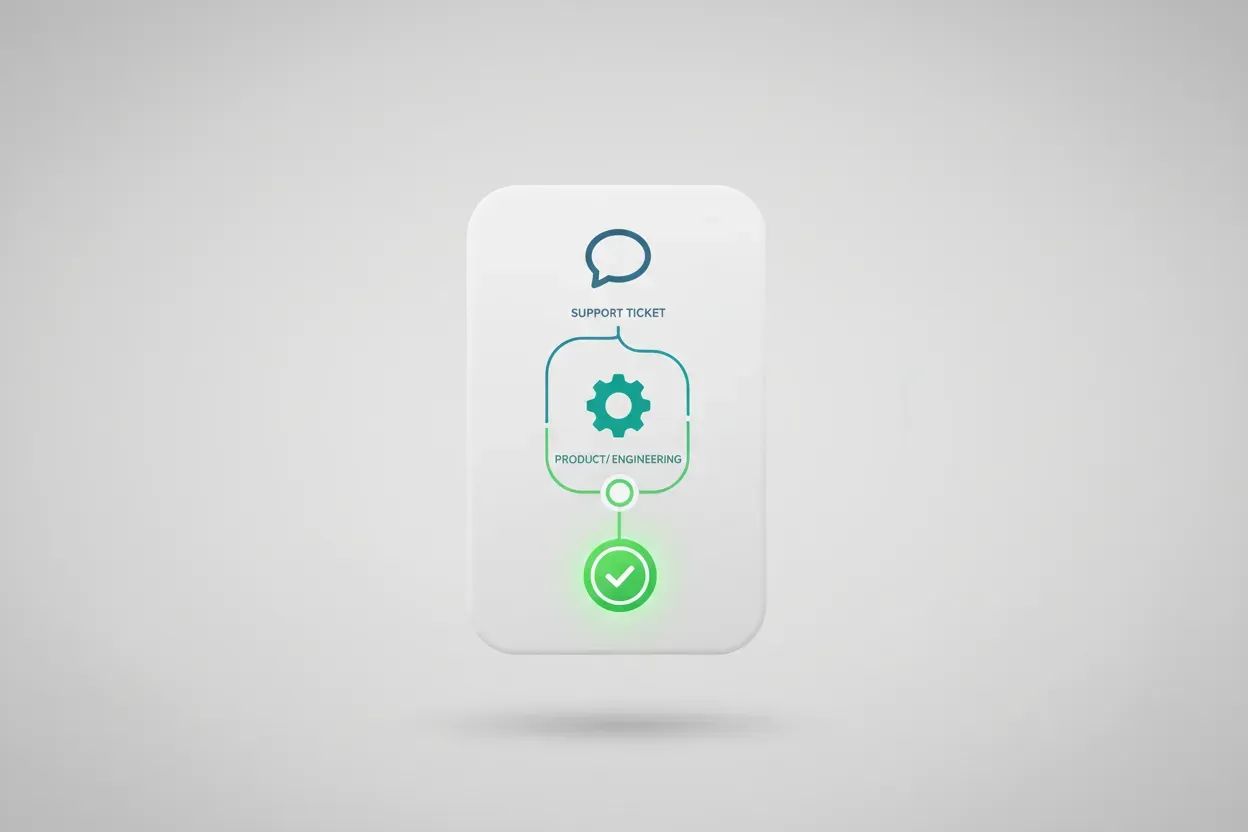
So we built a checkpoint directly into our CRM workflow. When a frontline ticket gets flagged for escalation, it triggers a structured template the support layer must complete before it routes. If the template isn't filled, it bounces back. The customer gets an automated status update that says we're investigating, with a realistic timeline based on the severity tag. Once engineering picks it up, the CRM status changes again and the customer sees it in real time.
The result: our average resolution time on escalated issues dropped by roughly 40%, and the number of "any update?" follow-ups from customers fell off a cliff. Customers don't get anxious when they can see movement. They get anxious in silence.
The deeper principle is that most back-and-forth in escalations isn't a communication problem. It's an information completeness problem. People pass incomplete context upstream, then everyone pings each other trying to fill the gaps. Fix the input quality and the whole chain speeds up.
If your escalation process allows vague tickets to travel upward, you haven't built a system. You've built a game of telephone.
Assign Single Owner With Fixed Cadence
Founder · Paperless Pipeline
The rule we hold inside Paperless Pipeline is the "one owner, one ticket, one update cadence" rule. Every escalation gets a single owner on the support side, a single matching ticket on the engineering side, and a fixed update cadence the customer is told about up front. No exceptions.
Here is the before and after.
Before we adopted this, an escalation would bounce. Support would email engineering. Engineering would Slack support back. Two days later the customer would email asking for a status and nobody could find the thread. RE/MAX Plus in Rochester, a top-100 brokerage running about 90 transactions a month through us, told us that the worst part of any vendor relationship was being forgotten in a ticket queue. That stuck.
After we put the rule in place, every escalation has one named human at Paperless Pipeline who owns it from intake to resolution. That person posts an update at a promised cadence: every 24 hours for normal severity, every 4 hours for a billing or audit-readiness issue, every hour for a closing-day blocker. Even if the update is "still investigating, here is what we ruled out", it goes out on time. The promise of the next update matters more than the content of the current one.
The checkpoint that reduced the most back-and-forth is the "what would close this for you" question, asked once, in writing, at intake. Brokerage operations people answer that question precisely. We have closed escalations in one engineering cycle that used to take three, because we stopped solving the wrong problem.
We are a small team. Fewer than 50 people, mostly remote since 2009. We do not have a dedicated escalation manager. The owner is whoever picked up the original ticket, and they stay with it until the customer says it is done. That is the cost of the rule. It works because nobody hands off.
If you want this to stick, write the cadence into the auto-reply, not the playbook. Customers trust the system they see.
Keep Human In Loop For AI
We run escalations based on 4 different criteria: Urgency, Sentiment, Response Time, and Frontline Skill. Our CRM is powered by AI automation so it flags these if they exceed thresholds and escalates. The AI can also auto generate a response for the client but the one rule is to have a human in the loop.